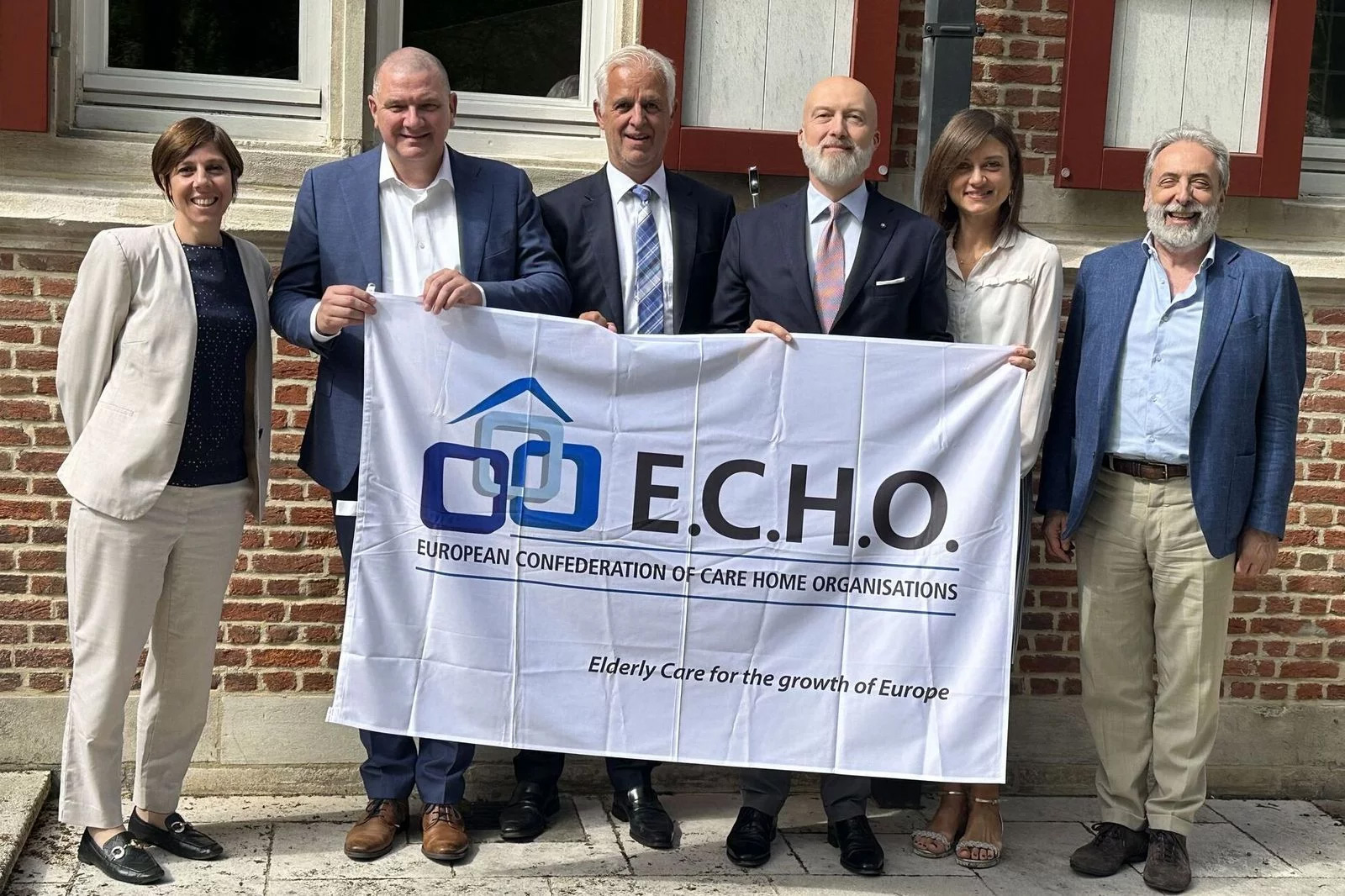
In the European context we are working on aWelfare that, by enhancing human capital and focusing on technological innovation and humanisation of care,can respond more effectively and efficiently to the health needs of the elderly. The challenges of a perpetually ageing population in Europe are the focus of the new ECHO team. The elective General Assembly ofE.C.H.O.,the European Confederation of Care Home Organisations, was held inBrussels.
The elected board remains in office for thetwo-year period 2024-2026. Reconfirmed as President is the entrepreneurAverardo Ortafrom ANASTE (Italy).
Re-elected, and for them also a reconfirmation,Bernard Meurerof BPA (Germany) Vice President,Sebastiano Capursoof ANASTE (Italy) Treasurer,Alberto Echevarriaof FED (Spain) General Secretary.
Delighted with his reconfirmation, ECHO PresidentAverardo Orta:
“The level of civilisation within a society is measured by how well it takes care of the frail and the elderly. To provide dignified care for the frail and elderly population in the coming years, urgent investment and dedicated EU policies are required. TheEuropean Confederation of Care Homesis poised to play its part in sharing the experience and expertise needed at European level to create a new form of Welfare capable of facing the challenges ahead”.
GROWING OLD AND THE FUTURE: ECHO’S CHALLENGES
Asthe OECD points out in its annual “Health at a Glance 2023”, the population is expected to age steadily and progressively in the coming years. By 2050, in OECD member countries, the population aged 80 years and over will double on averagefrom 4.8% to 9.8%.
On average, in OECD (Organisation for Economic Cooperation and Development) countries, people aged 65 might expect to live another 19.5 years. Life expectancy for those aged 65 is around 3.3 years longer for women than for men. A gender gap that has not substantially changed since 2000.
Unhealthy lifestyles and health risk factors remain prevalent, for example,19.5% of the adult population are living with obesity on average.
Another issue to consider is that21 millionpeople in OECD countries have dementia. If current trends continue, this number could increase by almost 50% by 2040, reaching almost 32 million people in all OECD countries.Japan, Italy and Germanyhave the highest prevalence of dementia.
And lastly, there is a divide in access to care. The digital transformation of healthcare systems offers opportunities to improve clinical care, research and system management. However, in only 42% of countries can the public access and interact with their data through existing electronic health portals.
On all these challenges, ECHO will continue to focus on the future by working alongside the European institutions.
ECHO
The confederationwas founded in1989in Brussels in order to promote, in cooperation with the European institutions, the improvement of the social and health care sector, care for theelderlyas well as for thedisabled, using the principle of cooperation of all its member states. Websitewww.echo-eu.com. Strategic Consultant is Ilaria Giannico. Collaborations withHFEandEU Health Coalitionare ongoing.